2.2 Renewable Energies
2.2 Renewable Energies
This chapter discusses renewable electricity as the central raw material for green hydrogen production. It highlights the three origins of renewable energy: geothermal heat, solar energy, and gravity. Technologies such as photovoltaic systems, wind turbines, and hydropower plants are used to generate renewable electricity. Hydropower and biomass have limitations, making photovoltaic systems and wind turbines the main options for large-scale green hydrogen production.
Photovoltaic systems
Solar cells are the basis for generating electrical energy in photovoltaic (PV) systems and are able to convert the radiation energy of the sun directly into electrical energy. The basic principle for this conversion is the so-called photoelectric effect. In the photoelectric effect, the energy of photons, which can be imagined as the smallest units of light, is transferred to electrons. To ensure that this energy transfer can take place and finally lead to the generation of electrical energy, the material of the solar cells is crucial.
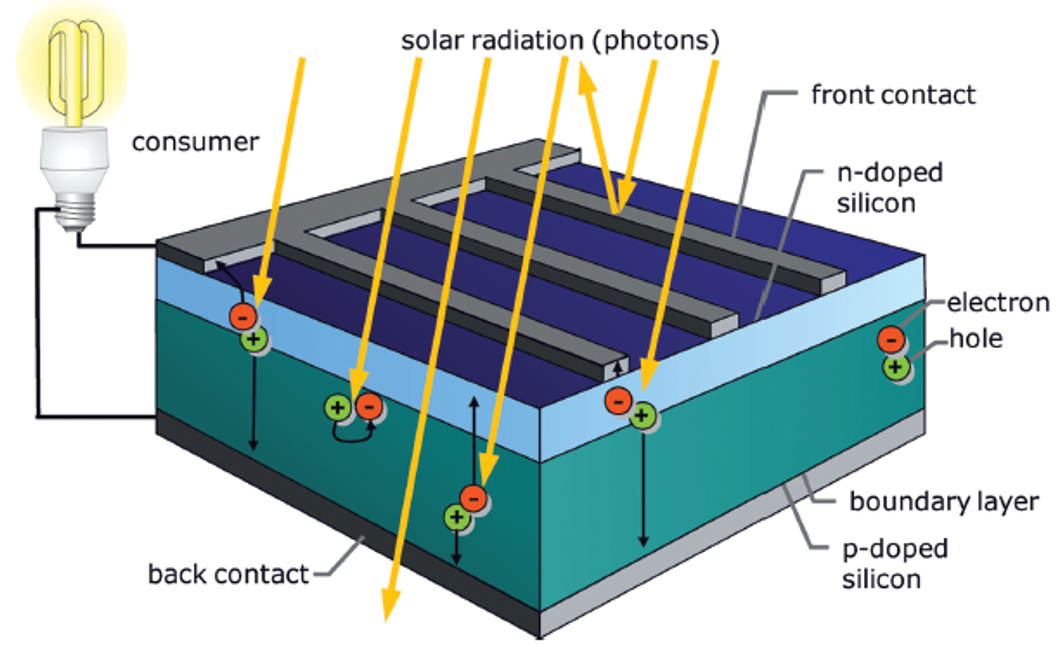
A central parameter for describing the technological performance of solar cells is the electrical efficiency. The electrical efficiency describes how much of the radiant energy arriving at the solar cell is converted into electrical energy. Currently, commercially available solar cells achieve an efficiency of 17 to 20 %. Most of the losses occur because only part of the incoming photon energy is transferred to the electrons due to physical limitations. Since solar cells generate direct current, but the electricity grid in Germany, as well as most consumers, need alternating current, PV systems are usually equipped with an inverter. The conversion in the inverter causes further losses, but these are small compared to the internal losses of the solar cell.