1.5 Prompting
1.5 Prompting
Ask better questions to get better answers: Prompting is the new key skill when working with AI.
The quality of the output from a generative AI system depends largely on the input – the so-called prompt. A well-formulated prompt helps the AI to accurately grasp your intention and, building on that, generate relevant, coherent or creative results. Unclear, vague or ambiguous requests, on the other hand, often lead to unusable results.
What makes a good prompt?
An effective prompt is:
- specific (What exactly should the AI do?)
- structured (How should the information be organised?)
- contextual (Which situation, target audience or perspective is relevant?)
Example from an academic context:
❌ "Write a text about artificial intelligence."
✅ "Write an introduction for an academic essay on the societal opportunities and risks of generative AI models. Target audience: first-year Bachelor’s students in the social sciences"
Eight elements for strong prompts (especially for image generation)
When working with image AI, you can structure your prompts in a targeted way. The following eight elements will help you generate nuanced and controlled outputs:
- Subject – What should be the focus? Example: "a medieval library"
- Action – What is happening? "A person reading by candlelight"
- Setting – Where is the scene set? "Indoor setting, dark wood, tall shelves"
- Lighting – What is the lighting like? "Warm, diffuse light source from the left"
- Style – In what style should the image be created? "In the style of a Renaissance painting"or "As a formal, official letter"
- Composition – How is the image structured? "central perspective, symmetrical"
- Feeling – What mood should be conveyed? "melancholic, calm"
- Adjectives – Which characteristics are important? "dusty, venerable, mysterious"
Feel free to use technical terms – such as those from photography – to guide your prompts. Separate instructions with commas or line breaks to keep things clear.
Prompting is a key skill
The ability to formulate effective prompts is not a technical nicety – it is central to the thoughtful use of generative AI. Whether you are preparing a presentation, creating learning materials or visualising a complex topic: the right prompt determines how much control, creativity and quality you can get out of an AI tool.
Here you will find a wealth of materials, step-by-step guides and helpful websites with tips on the topic of prompting – ideal for getting started and deepening your knowledge.
- ChatGPT Prompt Engineering for Developers
- KI Campus: Open Prompt Catalogue (in German)
- KI Campus: Moodle course on the Prompt Lab: Generative AI in Higher Education (registration required)
- Publication: Optimising Feedback in Higher Education: An Exploratory Study on Prompt Engineering and the Quality of AI Feedback
- Prompt Engineering Guide
- The Decoder: Prompt Strategies for Better Results
- TU München: ChatGPT-4 Cookbook for Good Prompts
- VILA Lab, Mohamed bin Zayed University of AI: Principled Instructions Are All You Need for Questioning LLaMA-1/2, GPT-3.5/4
C.R.E.A.T.E. Improvement Strategy:
Various methods and strategies can be employed to improve the quality of results when using AI systems and to avoid so-called hallucinations. One of these is the so-called C.R.E.A.T.E. method. It consists of several elements specifically designed to optimise the AI’s output. Particular emphasis is placed on the importance of clear and precise wording, embedding within the relevant context, and the ability to incorporate feedback.
C.R.E.A.T.E. stands for the six components: Character, Request, Examples, Adjustment, Type of Output and Extras. For each of these aspects, there are specific guidelines to be taken into account when applying the method:
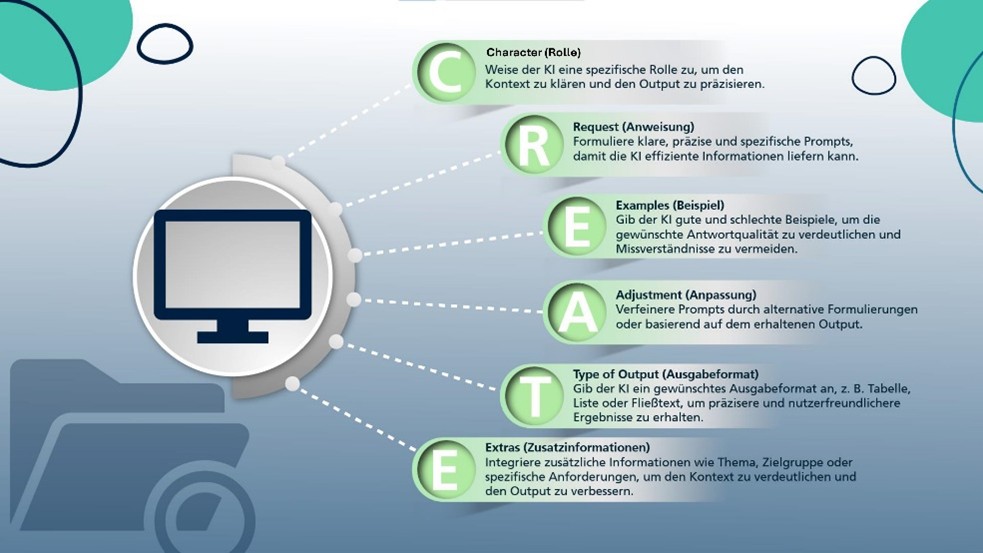
C.R.E.A.T.E. Framework by Fraunhofer IAIS (CC BY-SA)
💡 Learning Summary Chapter 1.5: Prompting
- Prompting is crucial for the quality of AI responses: Clearly formulated, structured and context-specific prompts lead to more precise results. The wording directly influences the behaviour and output of the AI.
- Targeted prompt design using 8 elements: By providing details on motif, plot, setting, lighting, style, composition, mood and adjectives, image or text prompts can be designed with precision – technical terms are helpful.
- A wide range of resources enhances prompt knowledge: Open-access courses, studies, frameworks (such as C.R.E.A.T.E.) and example catalogues provide support for getting started and delving deeper into systematic prompt engineering.