Soil and Pollution
Soil and Pollution
Soil and its Functions 2
The Federal Soil Protection Act recognizes soil as performing three categories of essential functions, which contamination can impair (BBodSchG §2):
Natural Functions:
Habitat function: Soil provides living space for soil organisms, plants, and animals. Contamination can destroy soil biodiversity and disrupt food webs.
Water and nutrient cycling: Soil filters, stores, and transforms water and nutrients. Heavy metal contamination or soil sealing disrupts these cycles.
Filter and buffer function: Soil can immobilize or break down pollutants, protecting groundwater. However, this capacity is limited—once exceeded, soil becomes a contamination source rather than a barrier.
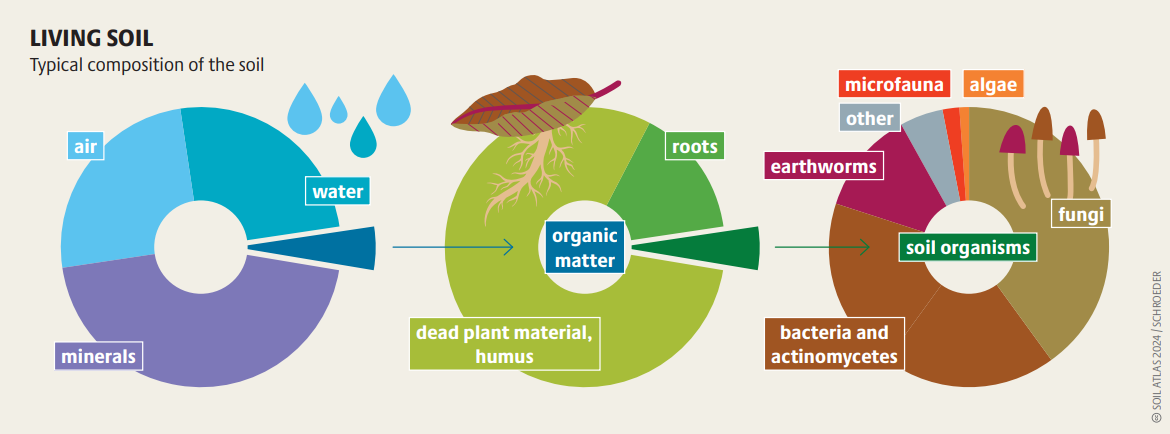
Image from The Soil Atlas 2024 by Heinrich-Böll Stiftung. Published under CC BY 4.0
Soil preserves evidence of natural and cultural history: geological formations, archaeological remains, and records of land use changes. Contamination investigation must sometimes balance remediation needs with preserving historically significant sites.
Functions for Human Use:
Agricultural production: Food and fiber production
Forestry: Timber production and recreation
Settlement and infrastructure: Foundation for buildings and transportation
Raw material extraction: Source of clay, sand, gravel
Recreation: Parks, gardens, sports fields.
Soil is a Non-Renewable Resource
A former industrial site cannot support residential gardens if concentrations of pollutants in soil exceed hazard thresholds. Understanding which soil functions are impaired guides both risk assessment and remediation target-setting.
Soil forms
extremely slowly- developing just one centimetre of topsoil can take decades to
centuries depending on climate and parent material. Industrial contamination
that destroys soil functions can require equally long timeframes for natural recovery,
if recovery is possible at all. Some persistent contaminants like heavy metals
never degrade; they can only be removed or immobilized.
This
near-permanence explains Germany's precautionary approach to soil protection
and why contaminated site remediation prioritizes protecting soil functions for
future generations.