Soil and Pollution
Soil and Pollution
Soil and its Functions 1
Before examining what contaminates soil, we must understand what soil is and why its protection is essential. Soil is far more than "dirt"- it is a living, dynamic system that performs critical functions for nature and ecosystems. Understanding these functions explains why soil contamination receives dedicated legal protection under the BBodSchG and why contaminated site remediation is a priority in urban redevelopment.
What is Soil?
Soil consists of mineral particles derived from weathered rock, organic matter from decomposed plant and animal material, water, air, and countless living organisms. This complex mixture develops over centuries through physical, chemical, and biological processes. A single handful of healthy soil contains more organisms than there are people on Earth: bacteria, fungi, protozoa, nematodes, and other microorganisms that drive essential ecosystem processes(Blume et al., 2016).Soil structure is organized in layers called horizons. The uppermost layer, topsoil, contains the highest concentration of organic matter and biological activity. Below this lies the subsoil, and deeper still the parent material from which soil forms. Contamination can affect any of these layers, with different implications for remediation strategies.
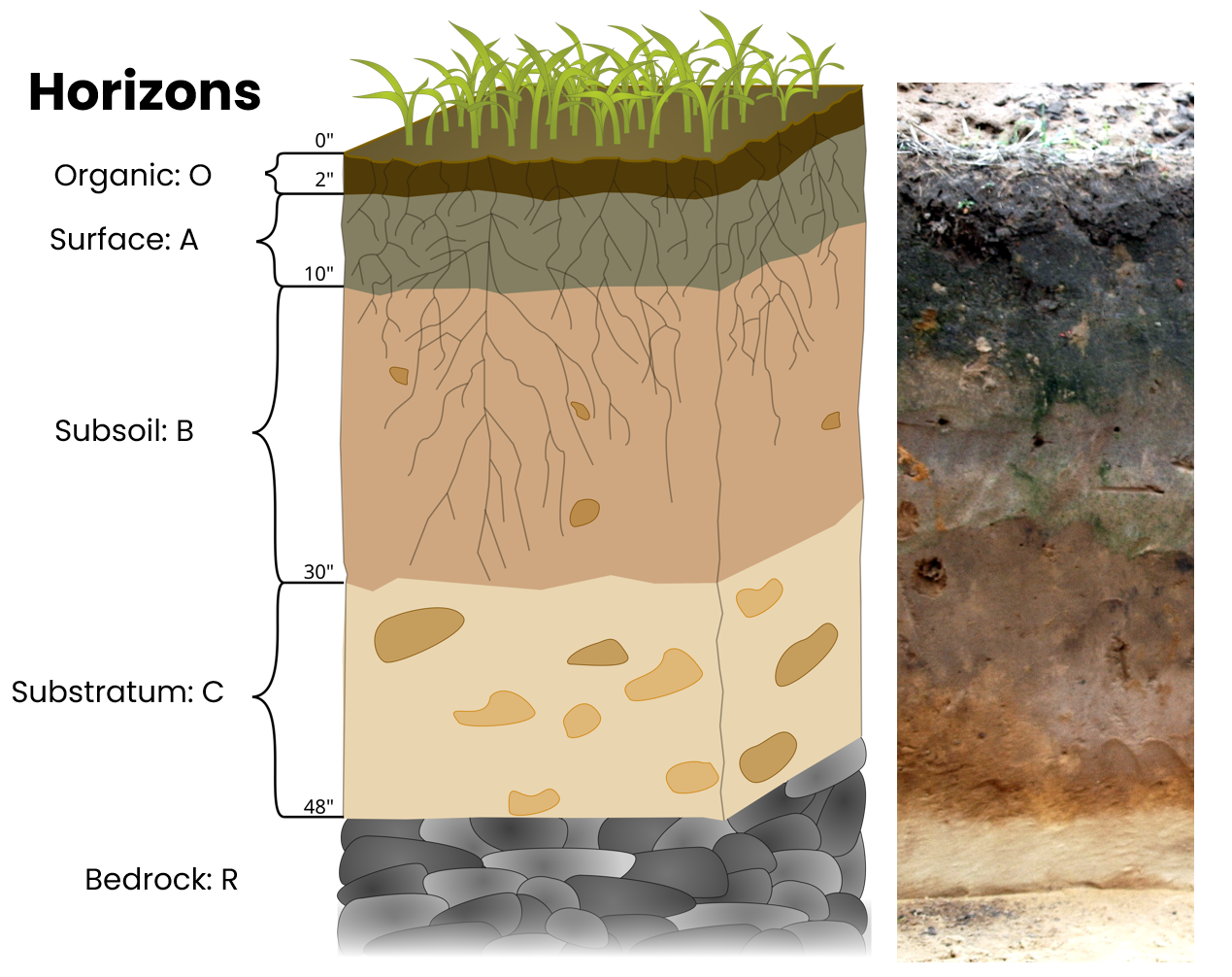
A cross section of a soil, revealing horizons. Created by author using images by Zwiadowca21 and Wilsonbiggs from Wikimedia. Licensed under the CC BY-SA 4.0
Legend: Soil Horizons
The numbers represent depth below the ground surface, measured in inches (").
O Layer (Organic Layer) The very top is a blanket of fallen leaves and plant debris. The upper part looks fresh, while the bottom is dark and decomposed.
A Horizon (Topsoil) The dark, rich layer where most plants grow. This is full of organic matter (decomposed plants and living organisms) and has a crumbly texture. It's usually dark brown or black from all the organic content.
E Horizon (if present) A lighter-colored layer where rainwater has washed minerals downward, leaving behind a paler, sometimes grayish zone.
B Horizon (Subsoil) A reddish-brown or yellowish layer below the topsoil. Less organic matter here, so the color comes mainly from iron rust. This layer catches minerals and clay washed down from above.
C Horizon (Parent Material) Broken-up rock material that's barely weathered. This is the "raw material" that slowly breaks down to form soil above.
R Layer (Bedrock) Solid rock at the bottom that can't be dug with a shovel, the foundation everything sits on.
Pollutants can enter at the surface and slowly migrate downward through the soil layers over time. Groundwater typically sits somewhere below these layers, and contaminants can eventually reach and pollute it if not addressed.
Soil Structure and Water Zones
The Unsaturated Zone (also called the vadose zone) extends from the ground surface down to the groundwater table. In this zone, soil pores contain both air and water. The water present- called soil solution or pore water- consists of water films coating soil particles and water held in smaller pores by capillary forces. Contaminants in the unsaturated zone can dissolve into this soil solution and migrate downward through seepage toward the groundwater (Fetter, 2001; Krebs et al., 2017).
The Saturated Zone lies below the groundwater table, where all pore spaces are completely filled with water. This water-saturated zone constitutes the groundwater aquifer. Once contaminants reach the saturated zone, they can travel laterally with groundwater flow over considerable distances, potentially affecting drinking water supplies or discharging into surface water bodies (Fetter, 2001).
The boundary between these zones (the groundwater table or water table) fluctuates seasonally depending on precipitation and groundwater extraction. Rising groundwater tables can mobilize contaminants from the unsaturated zone, while falling tables can leave contaminated soil exposed to air, increasing volatilization of certain compounds.
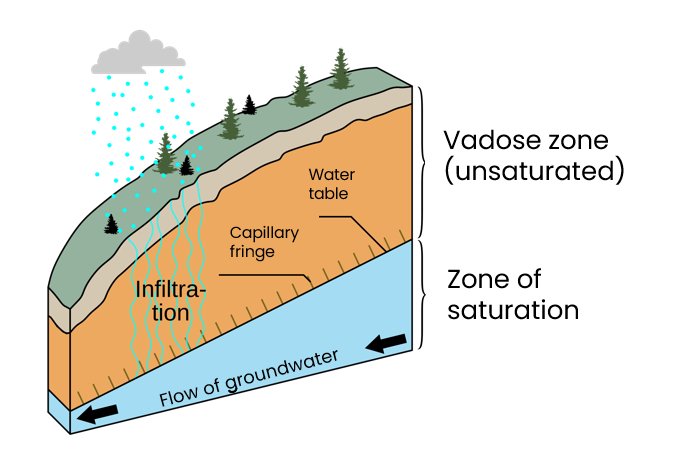
Vertical soil structure and groundwater zones. By Mrmw, based on: Vadose zone, Infiltrazione on Wikimedia Commons. Licensed under the CC BY 4.0