Organic Pollutants
Organic Pollutants
Dioxins
“Dioxins” is an umbrella term for a group of chemically related compounds - primarily polychlorinated dibenzo-p-dioxins (PCDDs) and polychlorinated dibenzofurans (PCDFs)(WHO, 2023).
Note: Brominated structural analogues (PBDDs/PBDFs) exist but are rarely encountered at contaminated sites and are not typically included in standard dioxin assessments.
The molecular backbone consists of two benzene rings: in PCDDs they are connected by two oxygen bridges, in PCDFs by a single oxygen bridge. Up to eight chlorine atoms can attach at specific carbon positions.
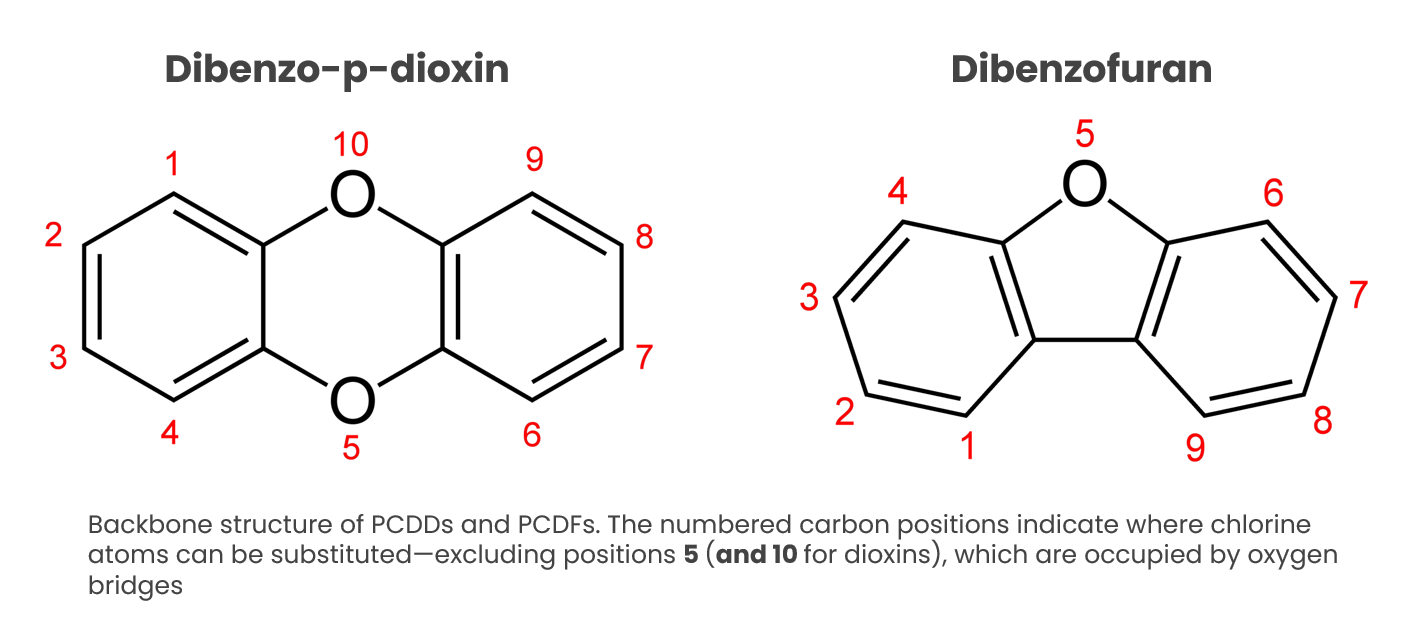
Figure created by author based on images by Benjah-bmm27 on Wikimedia Commons, published under CC BY 4.0
Each unique arrangement of chlorine atoms creates a different congener. In total, there are 75 possible dioxins (PCDDs) and 135 possible furans (PCDFs) -altogether 210 variants.
📊 Click to view full list of dioxin and furan congeners
| Homologue | Abbreviation | Chlorines | Number of Congeners |
|---|---|---|---|
| Polychlorinated Dibenzo-p-dioxins | PCDDs | ||
| Monochlorodibenzo-p-dioxins | MCDD | 1 | 2 |
| Dichlorodibenzo-p-dioxins | DCDD | 2 | 10 |
| Trichlorodibenzo-p-dioxins | TrCDD | 3 | 14 |
| Tetrachlorodibenzo-p-dioxins | TCDD | 4 | 22 |
| Pentachlorodibenzo-p-dioxins | PnCDD | 5 | 14 |
| Hexachlorodibenzo-p-dioxins | HxCDD | 6 | 10 |
| Heptachlorodibenzo-p-dioxins | HpCDD | 7 | 2 |
| Octachlorodibenzo-p-dioxin | OCDD | 8 | 1 |
| Total PCDD Congeners | 75 | ||
| Polychlorinated Dibenzofurans | PCDFs | ||
| Monochlorodibenzofurans | MCDF | 1 | 4 |
| Dichlorodibenzofurans | DCDF | 2 | 16 |
| Trichlorodibenzofurans | TrCDF | 3 | 28 |
| Tetrachlorodibenzofurans | TCDF | 4 | 38 |
| Pentachlorodibenzofurans | PnCDF | 5 | 28 |
| Hexachlorodibenzofurans | HxCDF | 6 | 16 |
| Heptachlorodibenzofurans | HpCDF | 7 | 4 |
| Octachlorodibenzofuran | OCDF | 8 | 1 |
| Total PCDF Congeners | 135 | ||
Although all congeners share the same chemical skeleton, their behavior and toxicity can differ dramatically depending on how many chlorine atoms are present and at which positions. Certain substitution patterns - especially at the so-called 2,3,7,8-positions - make molecules particularly stable and biologically active (Hites, 2011).
Among many dioxin congeners, one compound stands out : 2,3,7,8-tetrachlorodibenzo-p-dioxin (TCDD). It has chlorine atoms exactly at the 2, 3, 7, and 8 positions- an arrangement that makes it both very stable and highly biologically active. Because of this, TCDD is often used as the reference substance when assessing the toxicity of other dioxins and furans.
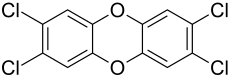
Structure of the TCDD. Created by Emeldir on Wikimedia Commons published under CC BY 4.0
One of the most infamous incidents involving TCDD was the Seveso disaster, which occurred on July 10, 1976, in Seveso, a small town in northern Italy (Eskenazi et. al., 2018). An accident at a chemical plant released a large cloud of hazardous substances, including significant amounts of TCDD, into the surrounding area. The contamination led to the evacuation of hundreds of residents and the slaughter of thousands of farm animals to prevent contaminated food from entering the food chain.
The most visible health effect was a skin condition known as chloracne, caused by dioxin exposure, which developed in many residents, especially children. Long-term studies have also indicated increased risks of certain cancers, endocrine disruption, reproductive problems, and developmental issues among those exposed (WHO, 2023).
💡 Quick Fact: Chloracne
Chloracne is a rare but characteristic skin disorder linked to exposure to dioxins. It resembles severe acne, with blackheads, cysts, and pustules, and can persist for years after exposure. The condition was first documented in West German chemical workers who handled chlorinated compounds in the early 20th century, making it one of the earliest recognized human health effects of dioxins. A much later and globally known case was the deliberate poisoning of Ukrainian president Viktor Yushchenko in 2004, whose disfiguring chloracne became a visible sign of extreme dioxin exposure.
You may recall the discovery of dioxin-contaminated waste in Georgswerder discussed in the course introduction. The identification of TCDD among that waste explains the scale of public and regulatory concern at that time.
The Seveso disaster became a turning point in environmental and industrial safety regulation. In response, the European Community (now the EU) introduced the Seveso Directive, a series of laws aimed at improving industrial safety and preventing major chemical accidents. These directives remain some of the most important pieces of legislation in Europe governing the handling of hazardous substances (EC, 2025).