Organic Pollutants
Organic Pollutants
Organic pollutants
Where inorganic pollutants persist indefinitely in soil systems, organic pollutants present a fundamentally different challenge: their carbon-based molecular structures can undergo transformation and degradation, but the rate and completeness of these processes varies dramatically based on molecular architecture.
Organic pollutants are classified based on their carbon backbone structure: chains (aliphatic), rings (aromatic), or structures incorporating halogens or other heteroatoms. This structural classification influences environmental persistence, with aromatic and halogenated compounds generally showing greater resistance to degradation than aliphatic hydrocarbons (Miniero et. al., 2015). 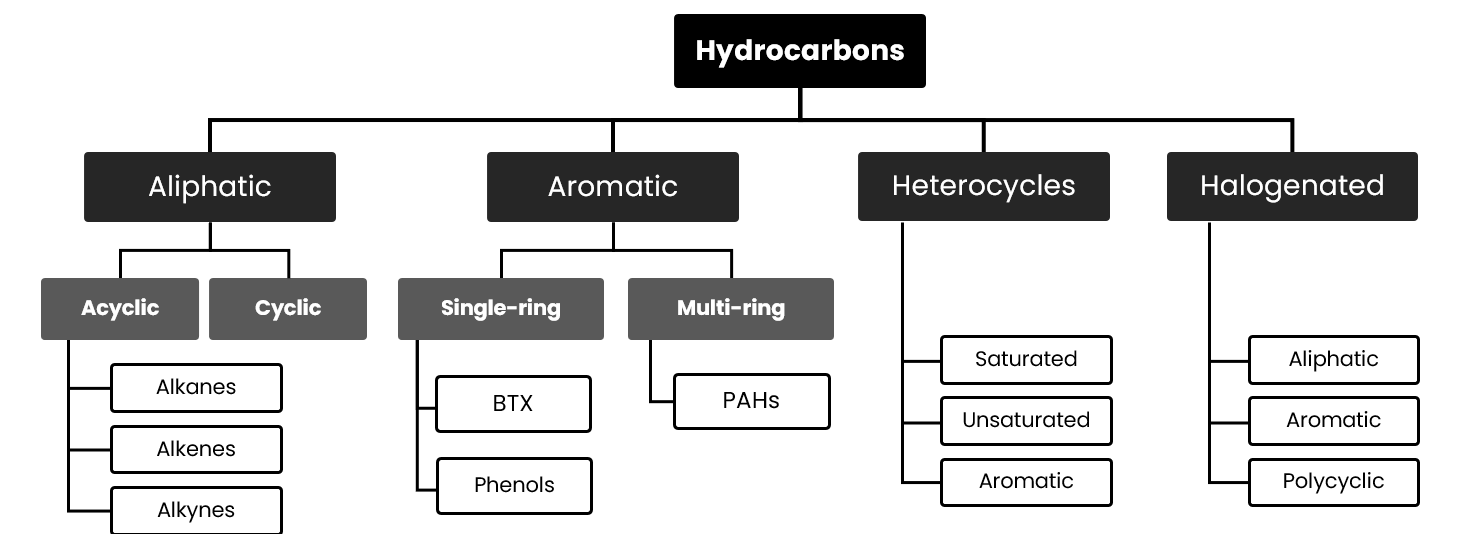
Structural classification of organic hydrocarbon contaminants. Created by the author, based on Hilberg (2022). Licensed under CC BY 4.0
It is important to note that this structural classification differs from property-based categories such as volatile organic compounds (VOCs), which span multiple structural groups and are defined by their tendency to volatilize at ambient temperatures. VOCs span multiple structural classes: BTEX compounds (aromatic), chlorinated solvents like TCE and PCE (halogenated), and light petroleum fractions (aliphatic) - are all VOCs despite their different molecular structures. This volatility creates specific exposure risks through inhalation and vapor intrusion into buildings, making VOCs a critical parameter in site investigations even though the term describes behavior rather than chemical structure.
ℹ️ Examples of molecular structures
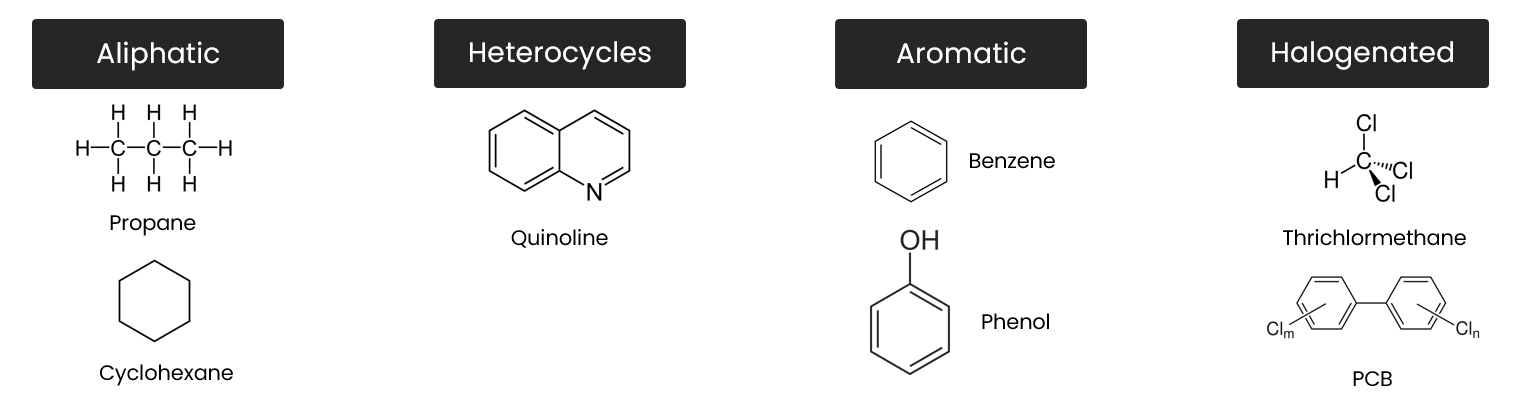
The four major structural categories are illustrated by representative compounds. Aliphatic compounds include propane (chain structure) and cyclohexane (ring without alternating double bonds). Aromatic compounds feature benzene rings, exemplified by benzene itself and phenol (benzene with a hydroxyl group). Heterocyclic compounds incorporate atoms other than carbon within ring structures, such as quinoline (containing nitrogen). Halogenated compounds are characterized by halogen atoms bonded to carbon, including trichloromethane and polychlorinated biphenyls (PCBs). These structural differences determine degradation rates, with aromatic and halogenated compounds typically persisting longer than aliphatic hydrocarbons.
Authos's note: One substance shown here is better known by a different name and frequently appears in crime movies as the "knockout cloth." Can you identify it? Why might this compound be both medically useful and environmentally problematic?
The following sections will examine specific organic contaminant classes in more detail.