In this experiment, the effect of soil salinity on plant growth will be demonstrated to the students and the online audience of the HOOU project SOILutions through the research-based learning approach. Soil salinity is a major worldwide problem affecting 20% of the global agricultural land, and this number is expected to rise to 50% by the year 2050, under the business as usual scenario. Soil being the natural resource necessary for the production of 99% of human food, soil salinity is an existential threat to humanity. In order to address this issue, a proper understanding and a wider acknowledgement of the problem is necessary, which is the aim of this project. Two plant species—common garden cress and common bush beans—will be under focus in this experiment. While as beans were selected by virtue of it being a source of nutrition worldwide, garden cress was selected for its fast growth dynamics, which makes a comparison easier.
Abschluss
Teilnehmer/innen müssen
Als erledigt kennzeichnen
SOILutions - Soil salinity and plant growth von Dr. Ing. Tavseef Mairaj Shah (CC BY)
Experiment 1: The effect of soil salinity on plant growth
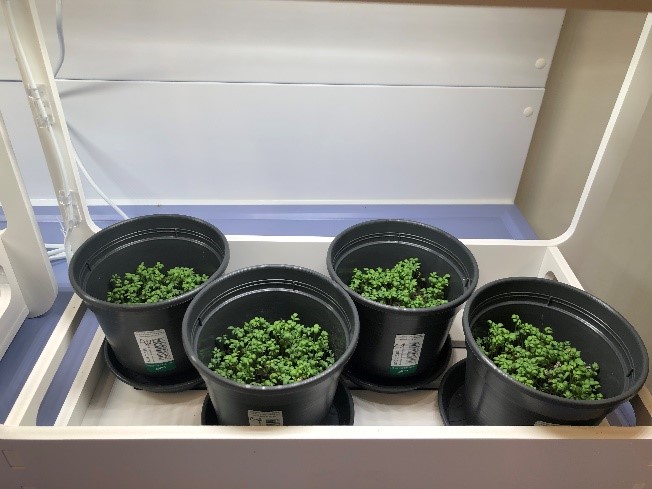
Garden cress growing von Dr.-Ing. Tavseef Mairaj Shah (CC BY)
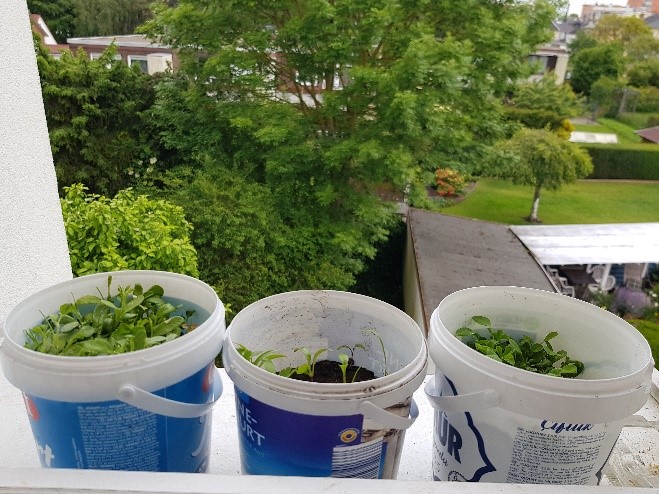
Plants growing in repurposed yoghurt cans at home von Dr. Ing. Tavseef Mairaj Shah (CC BY)
Materials needed:
Soil, common salt, cress seeds, beans seeds, planting pots (an egg tray or a yogurt can work as good), ruler, and kitchen balance
Procedure:
The two plant species will be grown in planting pots under saline and non-saline soil conditions. The procedure can be undertaken in the following steps:
Select the number of pots you want to use and divide them into two batches—for saline and non-saline treatments. Mark the pots accordingly as per your convenience.
Fill the pots with the appropriate amount of soil so as to keep some space to water the soil and mix it.
Put pure tap water into the pots marked for non-saline treatment and tap water mixed with common salt (1 to 5 g per liter) into the pots marked for saline treatments.
Mix the soil well in order to distribute the moisture and salt uniformly and sow the seeds into the soil. Use a little bit of soil to cover the seeds and the pots.
Place the pots at a warm location that gets a few hours of sun every day and is easily accessible for watering the pots.
Monitor the growth of garden cress for one week and beans for four weeks to observe the effect of salinity on the plant growth. Monitor the growth of the plants and document it in the form of photographs and length measurements.
You can share the results with us on the email address given below for publication in the final report.
At the end of the monitoring period, harvest the plants and do a mass measurement of the plant biomass (you can also let the healthy plants to grow on).
The results of the experiments and the knowledge gained in this project will be put together in the form of E-Learning videos published on the Hamburg Open Online University (HOOU) E-Learning platform.
Click here to download the pdf version of this handout.
Slideshow
Slideshow Soil and salinity von Dr. Ing. Tavseef Mairaj Shah (CC BY-SA)OutlookIn the next experiment, we will have a look at one of the possible solutions to mitigate this soil health challenge and hence reduce the effects of soil salinity on plant growth.